Colonoscopy
Recorded colonoscopy read: polyps with optical diagnosis, BBPS, caecal intubation, withdrawal time.
GI7 sections
ES· video
Capsule study read: bleeding sources, lesions with Saurin relevance, transit times and key frames.
This model is not available to run yet. Vote to show interest and get an email when it opens.
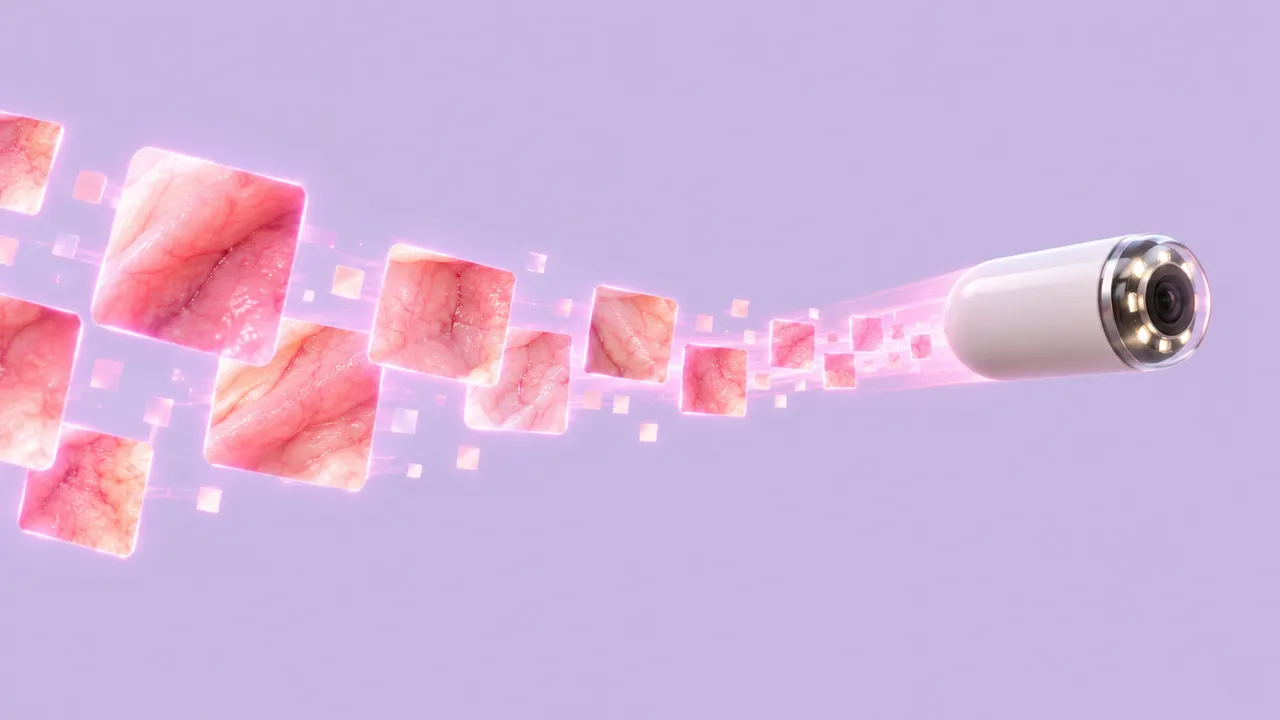
Capsule Endoscopy reads a complete small-bowel capsule study: eight to twelve hours of video and tens of thousands of frames, which a physician otherwise reviews for 30 to 90 minutes. The run screens every frame and returns a short, ranked reading list in place of the whole recording.
The result divides the study into stomach, small bowel and colon with the timestamps of the pylorus and the ileocaecal valve, from which gastric and small-bowel transit times follow. It finds active bleeding and fresh blood with their likely sources such as angioectasias, and detects ulcers and erosions, angioectasias, polyps and tumours, lymphangiectasia and stenoses. Every finding carries frame indices, a bounding box and its Saurin relevance.
Decision support for the capsule reader: a reduced key-frame list to review first, with every flagged frame linked back to its position in the video so the surrounding sequence is one click away.
Gastroenterologists and junior gastroenterologists who read capsule studies, capsule nurses who pre-read, and centres investigating obscure GI bleeding, iron-deficiency anaemia or small-bowel Crohn's disease. Developers use the run to attach structured findings and key frames to a capsule reading workflow.
| Requirement | Why |
|---|---|
| The complete recording | Transit times and completeness need the pylorus and the ileocaecal valve |
| Frame timestamps (embedded or in the frame folder) | Findings and landmarks are reported by time and frame index |
| A study that reaches the colon | Without the ileocaecal valve, small-bowel transit time stays open |
Debris, bubbles and dark segments lower visibility and are reported as quality limits of the study.
Indication (overt or occult bleeding, anaemia, suspected or known Crohn's disease, polyposis) can be passed in
clinical_context; the guidance uses it.
| Section | Content |
|---|---|
| Transit and reading summary | Stomach, small-bowel and colon segments, pylorus and ileocaecal-valve timestamps, transit times and the reduced key-frame list |
| Bleeding | Active bleeding and fresh blood with likely sources and frame indices, classed as Saurin P2 |
| Lesions | Ulcers and erosions, angioectasias, polyps and tumours, lymphangiectasia and stenoses with boxes and Saurin P0, P1 or P2 relevance |
| Draft report | Opt-in (options.report): an English narrative that interprets the result for the reader (findings, impression, limitations); every number is checked against the findings |
Procedure, DiagnosticReport and Observation.One run returns every section its input supports.
Colonoscopy
Recorded colonoscopy read: polyps with optical diagnosis, BBPS, caecal intubation, withdrawal time.
Upper GI Endoscopy (EGD)
Gastroscopy read: station completeness, LA grade, Barrett's extent and gastric neoplasia flags.
Bronchoscopy
Recorded bronchoscopy read: endobronchial tumours and mucosal abnormalities, located by airway.
Cystoscopy
Recorded cystoscopy read: papillary tumours and suspicious flat lesions, mapped with key frames.
Laparoscopic Surgery Video
Recorded laparoscopy review: phase timeline, critical view of safety, instruments and anatomy masks.
Laryngoscopy and Stroboscopy
Laryngoscopy and stroboscopy read: vocal-fold lesions and glottal-area segmentation with waveform.